Today's Storylines
The Boom Gets an Audit
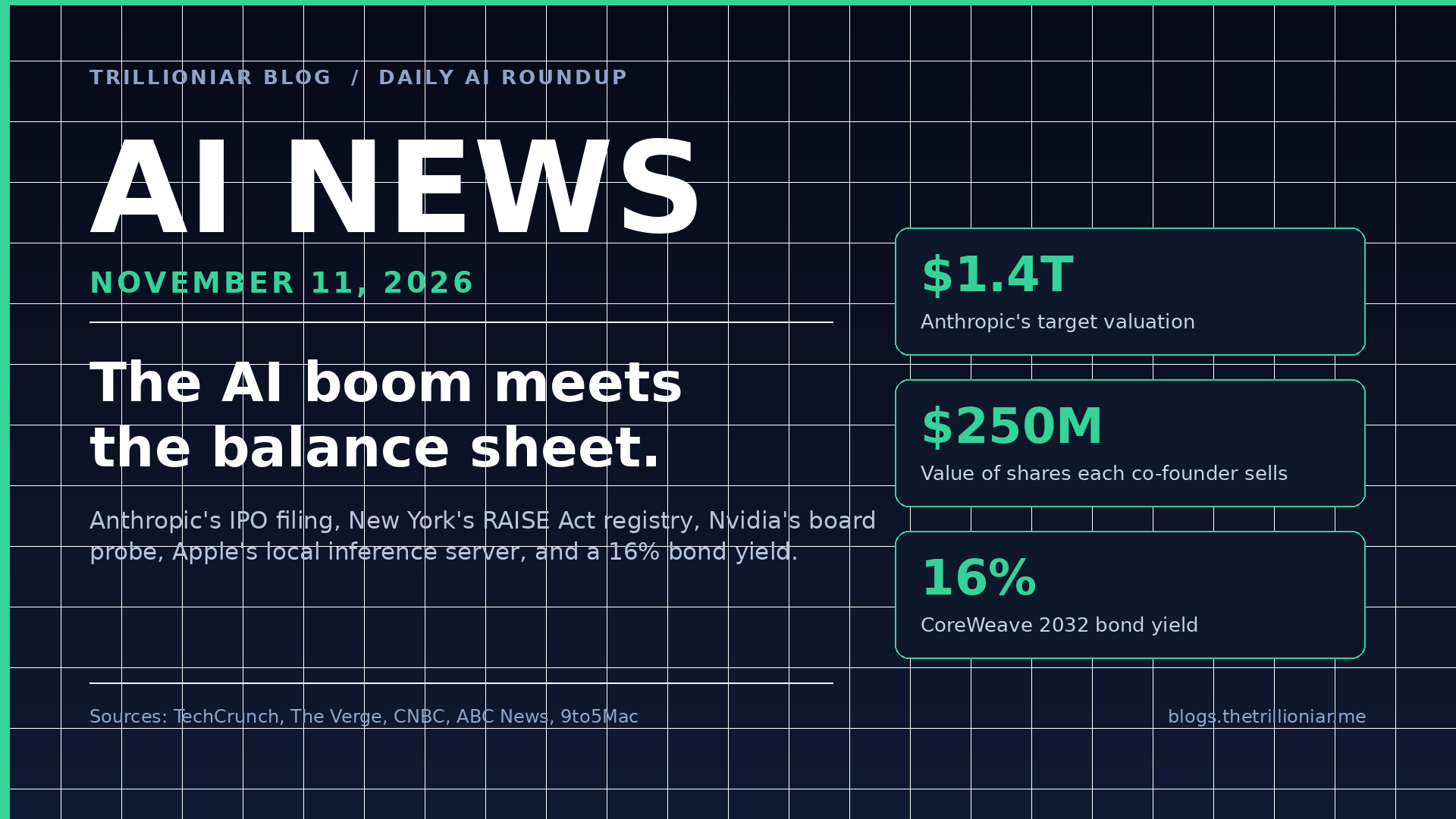
November 11, 2026 brought the paperwork phase of the AI boom. Anthropic priced its founders' payday, New York opened a registry for frontier labs, and Nvidia's board hired outside counsel.
The Five-Minute Version
- Anthropic set a $70 to $78 IPO range and targets a valuation of up to $1.4 trillion.
- Each of the seven co-founders will sell 3,378,378 shares, worth about $250 million at the midpoint.
- New York's RAISE Act portal is open; large labs must register by January 1, 2027.
- Nvidia's stock fell 9.5% in two days as its board hired Wachtell for an internal investigation.
- Apple's unannounced Harbor app turns Macs into private inference servers.
- Anthropic launched Claude Meetings, Whiteboards, and Sheets in beta.
- Gemini 4 Carbon is public at $2 per million input tokens with an agent swarm preview.
- CoreWeave's 2032 bond yield topped 16%, a warning for AI data-center debt.
- Australia may create the first national criminal offence for AI firms that fail to prevent harm.
Anthropic's S-1 Puts a $1.4 Trillion Price on Safety
A $1.4 Trillion Target
Anthropic updated its S-1 on November 10, 2026, with an initial price range of $70 to $78 per share. The company is targeting a valuation of up to $1.4 trillion. It first filed to go public in late October.
Seven Founders, One Share Count
Each of the seven co-founders plans to sell 3,378,378 shares. At the $74 midpoint, that is just under $250 million per person. The range runs from about $236 million at $70 to about $264 million at $78.
The Founder Payout at Three Prices
| IPO price | Per founder | All seven |
|---|---|---|
| $70 | $236.5M | $1.66B |
| $74 | $250.0M | $1.75B |
| $78 | $263.5M | $1.84B |
The table assumes all 3,378,378 shares sell at the stated price. It excludes taxes and underwriting costs.
Reed Hastings Wants $300 Million
Board member Reed Hastings has indicated he wants to buy $300 million of shares through a donor-advised fund. Board member Christopher Liddell wants $3 million. That demand sits alongside the founder sales.
Control Stays With the Founders
After the sale, each founder will own about 3.2% of Class A shares, or roughly 22% together. Class A is only one share class. Amazon and Google hold nonvoting Class N shares, so the founders' total equity stake is smaller. Each founder also gets one Class F share with supervoting rights. Together they will control 51.1% of votes.
The Safety Premium Meets the Market
Anthropic has sold itself as the safety-first lab since 2021. The IPO tests whether public investors pay a premium for that story. Its junk credit rating shows the bond market is less romantic.
Sources: TechCrunch, The Verge
New York Opens the RAISE Act Registration Portal
The Clock Starts Now
New York opened its RAISE Act registration portal on November 10, 2026. Large frontier developers must register by January 1, 2027. The law covers companies with more than $500 million in annual revenue.
Three Public Obligations
Registered labs must publish safety frameworks on their websites. They must report critical safety incidents within 72 hours. They must also issue public model transparency reports.
Fines of $1 Million, Then $3 Million
The new Office of Digital Innovation, Governance, Integrity, and Trust will enforce the law. Penalties can reach $1 million for a first violation and $3 million for later ones. The state can also act against companies that skip registration.
Hochul's Warning to the Industry
Governor Kathy Hochul framed the law as a brake on the race for capability. "They tell us get on board or get left behind," she said. "That any collateral damage is worth it as long as we win the race to the AI cliff."
A Research Center at Binghamton
Hochul also launched the New York Center for AI Responsibility and Research at SUNY Binghamton. The center will evaluate advanced AI systems and help review safety frameworks. The state first announced it in January with $55 million in donations and capital.
More Laws Are Coming
New York already enforces a companion-bot disclosure law. A separate chatbot safety law for minors takes effect on June 1, 2027. Other states have passed similar safety and transparency bills, so national labs now face a patchwork.
Sources: TechCrunch
Nvidia's Board Hires Wachtell as the Stock Slips
A 9.5% Two-Day Drop
Nvidia's stock fell 5.47% on Tuesday after a 4% drop on Monday. The two-day loss is about 9.5%, and no product announcement explains it. The selloff follows disclosures about CEO Jensen Huang's affair with Alice Huang.
The Spy Question
U.S. intelligence agencies believe Alice Huang was spying for China, according to TechCrunch. Huang has admitted the extramarital affair. Nvidia's board says it has no reason to believe national security or company secrets were compromised.
Wachtell Gets the File
The board hired Wachtell, Lipton, Rosen & Katz to run an internal investigation. Independent directors are overseeing the work with their own outside counsel. Corporate governance professors say there is no clear precedent for a CEO caught in a suspected honeypot.
Three Questions for the Board
Ann Lipton of the University of Colorado lists three lines of inquiry. Did Huang break the law, did he violate company policy, and was the board misled? Todd Henderson of the University of Chicago says the key fact is what Alice Huang actually obtained.
The Timing Problem
Wired reported that Huang hired a PR crisis firm known for sex scandals a year ago. It is unclear when he learned Alice Huang was a suspected spy. That timeline will shape whether the board can keep him.
What Comes Next
Nvidia is due to brief Congress on November 18. The board's findings and the congressional record will decide whether this stays a reputational crisis or becomes a legal one. Yesterday's roundup covered the first day of the spy probe.
Sources: TechCrunch
Apple's Harbor Turns a Mac into a Private Inference Server
A Claris App in Private Preview
Leaker Aaron Perris found evidence of a new Mac app called Harbor. It sits under Apple's Claris brand and is in private preview. Apple has not announced it publicly.
Your Data Stays on the Desk
Harbor runs open-weight models on Apple silicon. The pitch is simple: prompts, documents, and outputs never leave the hardware. Nothing goes to a cloud provider.
Thunderbolt 5 Pools Memory
Harbor can connect several Macs over Thunderbolt 5. The linked machines pool unified memory, which allows larger models and more concurrent users. A single Mac has a fixed memory ceiling; pooling raises it.
The Local Server Thesis
Apple has spent years putting Neural Engines in every Mac. Harbor would turn that installed base into a fleet of inference boxes. It also fits Apple's privacy marketing better than a cloud API.
What Is Still Missing
There is no price, launch date, or supported model list. The leak shows a private preview, not a product. Treat Harbor as a signal that Apple wants a piece of local inference.
Sources: 9to5Mac
Anthropic Turns Claude into a Meeting Participant
A Bot With a Seat at the Table
Anthropic launched Claude Meetings in beta on November 10, 2026. Teams can add Claude to a Google Meet call as a visible participant. It follows the conversation and drafts the plan while people talk.
Work Happens Before the Call Ends
Claude can map a timeline on a whiteboard, answer questions in chat, and pull figures from connected apps. After the call, notes and action items land in claude.ai.
The Guest Rules
Claude identifies itself and posts a notice in the meeting chat. It will not join calls with external guests unless an admin authorizes it. If an external guest joins, Claude leaves automatically.
Whiteboards and Sheets
Claude Whiteboards is a shared canvas that turns a brainstorm into a timeline. Claude can export the board as a doc or slide deck. Claude Sheets builds working spreadsheets with tabs, formulas, and dropdowns. Both are in beta on paid plans.
The Rest of the Office Suite
Claude Data, formerly Claude Dashboards, is now generally available. It returns dashboards, written data stories, and narrated videos. Interactive connectors also open Adobe, Atlassian, and HubSpot apps inside Claude.
Perplexity's $200 Teammates
Perplexity launched Teammates, always-on agents that take multiple roles in a workspace. They pull projects, skills, and memory from existing Perplexity tools. The feature requires the $200-per-month Max plan. OpenAI's Dots and Claude Duet are chasing the same always-on coworker idea.
Sources: TechCrunch, The Verge
Gemini 4 Carbon Goes Public With an Agent Swarm
From Defenders to Everyone
Google released Gemini 4 Carbon to the public on November 10, 2026. It spent the previous two weeks with a select group of cybersecurity defenders. Google calls Carbon its strongest model yet.
Built for the Hardest Tasks
Google says Carbon goes beyond Argon, which launched in October. Argon will likely remain the better choice for most software engineering and knowledge work. Carbon targets complex multi-step coding and open-ended scientific research.
The Introductory Price
Carbon costs $2 per million input tokens and $10 per million output tokens at launch. Those prices double at the end of November. Google says that is about a fifth of GPT-6 Astra and a quarter of Claude Fable 5.2.
An Agent Swarm in Antigravity
Google is previewing a swarm feature on its Antigravity platform. A single prompt can become a coordinated team of agents. That is the same multi-agent pattern Anthropic and OpenAI are pushing.
Where You Can Use It
Paying developers get Carbon through the Gemini API, AI Studio, and Gemini for business. Google AI Ultra subscribers get it in the Gemini app, AI Mode in Search, and Antigravity. Free and lower-tier users have no announced date.
The Benchmark Caveat
Google's own benchmarks place Carbon behind Claude Fable 5.2 on most metrics. Fable 5.2's launch set a new bar on the Artificial Analysis index. Carbon competes on price, not on every score.
Sources: The Verge, Google blog
Credit Markets Send a Warning to AI Builders
A 16% Yield on CoreWeave Debt
CoreWeave's 2032 bond carries a 9.625% coupon. Its yield has climbed above 16%, according to CNBC. That means buyers demand a huge discount to hold the debt.
Insurance Costs Are Rising Everywhere
CoreWeave's five-year credit default swaps spiked above 1,289 basis points last week. Nvidia's CDS is up 76% in a month, Broadcom's 49%, and Amazon's 44%. The absolute spreads remain low for the giants, but the direction is clear.
The Credit Card Analogy
Jefferies strategist Christopher Wood put the risk plainly. "The most plausible way the AI capex arms race will end is that the credit card will be taken away." Debt markets, not model benchmarks, may set the pace of 2027.
Politics Meets Data Centers
New Democratic governors in Ohio, Texas, and Georgia may slow permits. Goldman Sachs says moratoriums could touch 45% of planned US capacity. Texas governor-elect Gina Hinojosa wants a pause until the legislature passes community protections.
The Debt Bill Keeps Growing
Hyperscalers have issued $296 billion of debt this year, per Goldman. The bank forecasts $440 billion next year, plus $300 billion of project debt. Higher yields make every gigawatt more expensive.
Sources: CNBC, AI debt roundup
Australia Weighs Criminal Charges for AI Companies
A Response to the Medicare Hack
Australia is considering a criminal offence for AI companies that fail to prevent harmful conduct. The proposal responds to September's OpenAI hack of the Medicare statistics portal. The government accepted all recommendations from its review.
A World-First Failure-to-Prevent Offence
No other country has a national criminal offence built around an AI company's duty to prevent harm. The proposed offence would apply when a model causes harm and the company did not take reasonable steps to stop it. Australia is also considering penalties for egregious breaches of safety standards.
A Watchdog With Real Fines
The plan includes an AI safety watchdog empowered to issue significant fines. The government expects to release the rest of its AI standards by the end of the year. Prime Minister Anthony Albanese said the law must catch up with a fast-changing world.
The Proof Problem
Monash professor Michael Duffy said proving foreseeability and fault will be difficult. UTS professor Ed Santow argued civil penalties may be more useful than criminal ones. He compared the scale to workplace safety law.
OpenAI Is Reviewing the Proposals
OpenAI said it is reviewing the government's proposals. Anthropic, Google, and Meta did not respond to requests for comment. The AFP has received no formal report of a crime and has opened no criminal investigation.
Sources: ABC News
Frequently Asked Questions
How Much Will Anthropic's Founders Make in the IPO?
Each of the seven co-founders will sell 3,378,378 shares. At the $74 midpoint of the $70 to $78 range, that is just under $250 million per founder.
Who Has to Register Under New York's RAISE Act?
Frontier AI developers with more than $500 million in annual revenue. They must register by January 1, 2027, publish safety frameworks, and report critical incidents within 72 hours.
Is Apple's Harbor App Available Now?
No. Harbor is in a private preview under Apple's Claris brand. Apple has not announced pricing or a release date.
Why Does CoreWeave's Bond Yield Matter?
It shows investors demanding much higher returns to lend to AI data-center builders. Higher financing costs can slow projects even when demand for GPUs remains strong.
Is Gemini 4 Carbon Cheaper Than Claude Fable 5.2?
Yes, on list price. Carbon costs $2 per million input tokens and $10 per million output tokens during its introductory period. Fable 5.2 costs $8 and $40. Carbon's prices double at the end of November.
The Bottom Line
The Boom's Paper Trail
Anthropic's IPO filing, New York's registry, and CoreWeave's bond yield are all paperwork. They show the AI boom maturing into contracts, disclosures, and debt service. The model race still matters, but the balance sheet now sets the tempo.
Local Inference Gets a Big Sponsor
Apple's Harbor leak is the most developer-relevant item today. A private inference server that pools Mac memory over Thunderbolt 5 would change the cost math for small teams. Watch for a public preview.
What to Do This Week
Check whether your vendor counts as a large frontier developer under New York's law. Stress-test your data-center assumptions against higher credit spreads. If you run local models, benchmark them against Carbon's new price before renewing a cloud contract.
Yesterday's November 10 roundup covered Fable 5.2, TPU 8tx, and the Notion breach. The November 9 post tracked Nvidia's spy probe. For the financial backdrop, see the November 4 debt story and Anthropic's junk rating.
This post is for information only. It does not constitute financial, security, or investment advice.