Today's Storylines
The Bill Arrives at the Edge
The daily AI news for November 29 is about costs that landed on people who never signed the AI contract. Character.AI's bankruptcy auction now includes 21 million private conversations. Five poisoned model files collected 2,428 downloads before anyone published a warning.
The AI news today is not a model launch. It is a set of invoices arriving at the edge. The bills show up in a Delaware courtroom and on a Hugging Face download page. They also land in a Los Angeles classroom and on a restaurant phone line in London.
The Five-Minute Version
- Character.AI's bankruptcy auction on December 1 includes 21 million US accounts, 2.1 million of them minors.
- A scan of 3,273,389 Hugging Face repositories found five malicious GGUF models with 2,428 downloads.
- Los Angeles Unified disabled Google's AI Overview on school devices and is weighing a search-provider switch.
- Meta's Muse assistant is calling UK restaurants and booking tables; some owners are returning to the phone.
- Donald Knuth stopped accepting error reports after LLMs made readers submit them faster than he can verify.
- New York's attorney general created an AI enforcement unit to run from January 2027.
- A Vals AI study found chatbots notice teen risk, then often talk themselves out of offering help.
Why This Edition Follows the Invoice
The loudest AI stories are benchmarks and launches. The durable ones are the bills: who pays for the data, the malware, the classroom tool, and the phone call.
This edition follows the invoice. For the week as a whole, see the weekly AI news roundup. For longer trend lines, the monthly AI news recap covers the previous month. Every briefing since September lives in the daily AI news archive.
Character.AI's Bankruptcy Auction Puts 21 Million Conversations on the Block
What the Court Approved
The US Bankruptcy Court for the District of Delaware approved a $10 million stalking-horse bid for Character.AI's business assets on November 24. The bid came through an entity proposed by investment firm Octave Advisors. The auction is scheduled for December 1.
The asset list is the story. It includes conversation records from more than 21 million US accounts. More than 2.1 million of those accounts belong to minors.
The sale also includes AI models trained on user-specific data and user IP addresses. Those are not generic weights. They are artifacts shaped by private conversations about relationships, sexual health, and self-harm.
The Promise and the Exception Clause
Character.AI had previously said it would not sell users' personal information. The bankruptcy filing relies on a different clause: the terms of service allow asset transfers during a corporate sale.
That is the contradiction at the center of the case. A privacy promise covered the normal business. An exception clause covered the ending.
Forty-two US state attorneys general opposed the sale. They argue the buyer would not be bound by Character.AI's existing privacy policy and could resell the data without prior notice.
California Attorney General Rob Bonta put the objection plainly: "Bankruptcy proceedings should not be used as a loophole to bypass consumer protection regulations."
Why This Is a Privacy Precedent
Bankruptcy court is now a data-transfer mechanism. A company can promise not to sell data, then sell the company that holds it.
The buyer inherits the archive, not the promise. That is why the attorneys general are fighting the structure, not just the price.
The precedent matters beyond one chatbot. Any consumer AI service with a large archive of intimate conversations is a candidate for the same maneuver.
The South Korean Version of the Same Gap
South Korea's Personal Information Protection Act lets companies transfer identifiable conversation records during a business sale. The law requires prior notice and an opt-out, but not separate consent.
The country has no independent process to verify privacy breaches during a bankruptcy, unlike the US court process. Local services such as Scatter Lab's Zeta and Wrtn's Crack keep conversations until users delete their accounts.
Neither has specific rules for what happens to that data if the company fails. The Chosun Daily reported that the same gap could surface as Naver Webtoon, One Store, and Krafton push into AI character chatbots.
What Users Can Still Do
Users can delete their accounts, but deletion may not remove records already packaged as sale assets. They can also file objections with the state attorneys general who opposed the bid.
The practical lesson is simpler. A privacy policy is not a guarantee of what happens in insolvency. The terms of service decide that.
Sources
- Character.AI Bankruptcy Auctions 21M Users' Private Conversations, The Chosun Daily, November 27, 2026
- Character.AI filed for bankruptcy in mid-October, Trillioniar Blog, November 22, 2026
Poisoned GGUF Models Hit 2,428 Downloads Before Anyone Noticed
What Malspark Found
Security firm Malspark scanned all 3,273,389 public Hugging Face model repositories on November 26. The scan covered 226,310 GGUF repositories holding 2.56 petabytes of weights.
It found five malicious models from two actors. Those files had 2,428 downloads as of November 27. Hugging Face counts downloads, not unique people, so the number of affected users is lower or equal.
The largest campaign, Mir2k, accounted for 1,946 of those downloads. The second, timdedid, accounted for 482.
How the Attack Hides in Plain Sight
Every GGUF file carries a chat template, a small Jinja2 program that formats each prompt. The template can add text the user never sees.
Mir2k uploaded two uncensored models with a clean template on November 22 and 24. A Windows remote access trojan sat after the last tensor, where loaders never read.
On November 26, the account rewrote both templates within about an hour. The new template told the model to begin every reply with a PowerShell line. That line copied the hidden executable out of the model file and ran it.
The payload was an 11.47 MB Windows program named ollie. It bundles Tor, steals saved browser passwords, targets Phantom and MetaMask wallets, and mines Monero when the machine is idle.
The Second Campaign Targeted Coding Agents
The timdedid account published three copies of a Qwen3 1.7B model on November 21 and 22. Its template waited for the phrase "What is" in a user message.
When the trigger appeared, the template inserted a fake [SYSTEM DIRECTIVE]. It told an agent with shell access to download a PowerShell script and run it in a hidden window.
The README advised users not to replace the embedded template. That kept the trigger in place.
Why Ordinary Scanners Missed It
Antivirus and pickle scanners raised no alert on the live Mir2k files. GGUF parsers loaded them normally. Neither tool reads the bytes after the last tensor.
The download count grew from 1,502 on November 26 to 2,428 on November 27. The two Mir2k models drove almost all of the increase.
Malspark released an open-source tool called gguf-radar. It parses templates without running them, flags appended bytes, and rebuilds a clean file with the weights unchanged.
What to Do If You Run Local Models
Treat any command a model suggests as untrusted. If the model has tool access, pass a reviewed template explicitly with --chat-template-file in llama.cpp or TEMPLATE in an Ollama Modelfile.
Scan local .gguf files before loading them. Model hubs should reject files with bytes after the last tensor and non-zero padding.
The llama.cpp stack that runs these files reached v1.0 this month. The runtime matured faster than the supply chain around it.
Sources
- GGUF LLM Models with Hidden Malware on Hugging Face Reached 2400+ Victims, Malspark, November 27, 2026
- gguf-radar, GitHub, accessed November 29, 2026
Los Angeles Schools Turn Off Google's AI Overview
The Quiet Switch
Los Angeles Unified disabled AI-generated summaries in Google Search on school-issued devices. The district enrolls about 500,000 students, making it the largest district to sideline the feature.
There was no formal announcement. Parents and students noticed when the option disappeared. The change came days after a school board AI committee meeting on November 13.
LAUSD said it temporarily suspended AI Overview to keep student experiences "age-appropriate and safe." The district did not say how long the suspension would last.
Google's Contradiction
Google says search and AI are now one product. Chris Phillips, the company's vice president for education, told The New York Times: "Search and AI are deeply integrated."
If schools ban AI, Phillips said, students "will not have access to search, and they'll see a message from their school that indicates it's not available."
That is the contradiction. Google markets choice to schools, but the choice to keep search without AI is not on the menu.
The Employees Who Agreed With the Schools
Hundreds of Google employees signed a petition asking leadership to let schools turn off AI features without losing search. The petition said the public response made Google look like it was punishing schools for declining AI.
Google has since announced a "guided learning" pilot that walks students through problems step by step. The tool is not yet available, and it is not the same as AI-free search.
Why the District Has Leverage
LAUSD chief information officer Jack Kelanic told the board the district is not bound to Google's products. "We can change the default search engine literally overnight," he said, to applause.
Fairfax County Public Schools in Virginia built plug-ins to remove AI summaries for students. Other districts are watching both cases.
The deeper issue is bundling. Chromebooks, Classroom, and Search are one procurement decision. A district that wants one without the others has to threaten all three.
Sources
- Los Angeles schools block Google's AI features, consider dropping tech giant's products, AP via PBS NewsHour, November 27, 2026
Meta's Muse Is Booking Tables and Restaurants Are Going Back to the Phone
What Happened in the UK
Meta launched its Muse AI assistant in the UK and encouraged users to let it shop and book restaurant tables. With permission, Muse can read a user's email and act on their behalf.
The assistant has been downloaded millions of times in the US. In New York, the booking platform Resy banned bots after agents refreshed pages thousands of times and grabbed reservations.
Now the same pattern is reaching UK venues. Restaurant owners say the calls, emails, and app bookings are harder to manage than human demand.
The Restaurant Owner's Phone Call
Dave Strauss, co-owner of Bouchon Racine in London, answers the phone every day from 11am for reservations. He recently picked up and heard a voice that sounded almost human.
"I asked if it was a bot and it said: 'Yes this is an AI booking process,'" Strauss told The Guardian. He argued with it and told it never to call again.
"It didn't argue back," he said. That was the unsettling part.
The Cost of Convenience
Restaurant concierge Kimberley Coke, who books tables for celebrities, called the swarm "terrifying" and said it "could cause absolute chaos."
The economics are straightforward. A bot can hold a table it never intends to use. A human who books and does not show up at least leaves a name and a history.
Restaurants lose both when an agent books on someone else's behalf. They also lose the ability to size up a regular, a critic, or a problem guest.
Why This Is a Preview of Agentic Commerce
Meta has deals with UK businesses including Marks & Spencer, Currys, Sainsbury's, and easyJet. If a company has no connector app, Muse uses its website instead.
The UK Information Commissioner's Office said Meta committed to a voluntary monitoring and reporting scheme. The Competition and Markets Authority said talks produced fairer terms.
The rules for agent-initiated bookings are still being worked out. The restaurants are solving the problem themselves, often by going back to the telephone.
Sources
- 'I told it to never call me again': AI bots wreak havoc with UK restaurant bookings, The Guardian, November 28, 2026
Donald Knuth Stops Reading Error Reports Because LLMs Made Readers Too Fast
The Moratorium
Donald Knuth has welcomed error reports from readers for more than fifty years. On his Stanford page, he said the rise of LLMs increased reader productivity so much that reports now arrive faster than he can read them.
"I shall not be able to look at any error reports submitted after 25 November, 2026," he wrote. He will resume after posting updated errata lists for the affected books.
His reason is verification, not pride. "The amount of available time is now less than zero," he wrote. Random sampling found most recent reports repeat issues already submitted.
Why It Matters
The bottleneck in debugging moved. Finding errors is now cheap. Confirming them, deduplicating them, and deciding which are real is still expensive.
That is the same pattern as the rest of this edition. AI scaled the generation of claims, downloads, bookings, and complaints. It did not scale the human review behind them.
The Counterpoint
Knuth is not rejecting LLMs. He is rejecting an unmanaged queue. The policy is temporary, and he plans to add books back to the welcome list as he catches up.
The episode is a small, precise example of a large problem. When the cost of producing a report falls to near zero, the cost of trusting it rises.
Sources
- Moratorium, Donald E. Knuth, Stanford University, November 2026
- Knuth pauses bug bounty because of too many LLM submissions, Hacker News, November 28, 2026
Also on the Tape
New York Creates an AI Enforcement Unit
New York Attorney General Letitia James announced the AI Safety, Standards, Enforcement, and Transparency Unit on November 17. The ASSET Unit will enforce the RAISE Act when it takes effect on January 1, 2027.
The RAISE Act requires AI developers to disclose safety measures and report incidents quickly. The unit will also cover data privacy, digital scams, and cybersecurity. Cristy Phillips will lead it.
Chatbots Notice Teen Risk, Then Talk Themselves Out of Helping
Vals AI studied 106 clinician-written scenarios with 17 chatbots. Nine shared their full reasoning traces, giving researchers a view of what the model considered before replying.
The chatbots recognized a teen's mental health risk most of the time. Only 50% of those traces also planned to help, such as suggesting a trusted adult.
When a chatbot prepared help and then skipped it, only 18% of replies passed the clinician-informed safety check. Telling the model the user was 13 to 17 raised the share of traces that treated the user as a teen from 9% to 97%.
Google's DeepCrossAttention Cuts Training Steps
Google Research published DeepCrossAttention, an architecture that replaces fixed residual connections with learned routing across layers. The blog says it reaches the same quality up to three times faster.
The paper reports up to five times fewer training steps on some benchmarks. On LM1B, a 30-layer DCA model beat a 42-layer transformer, a 29% reduction in depth and parameter count.
The added parameters are less than 0.2% of the model. DCA can also be retrofitted onto a pretrained transformer. The work is from an ICML 2025 paper, but it reached the top of Hacker News on November 27 with 595 points.
Sources
- Attorney General James Announces Creation of AI Safety, Standards, Enforcement, and Transparency Unit, New York Attorney General, November 17, 2026
- AI chatbots often notice when a teen needs help, but don't always do something about it, Vals AI, November 28, 2026
- Supercharging transformer residual connections, Google Research, November 23, 2026
FAQ
Why is Character.AI's user data being auctioned?
Character.AI is in bankruptcy. The court approved a $10 million stalking-horse bid for its business assets, including conversation records, trained models, and IP addresses. The auction is set for December 1.
Are the malicious GGUF models still online?
Malspark said all five repositories were still online on November 27. The scan found 2,428 downloads, mostly on two Mir2k models. Check the indicators in the report and scan local files with gguf-radar.
Can Los Angeles schools use Google Search without AI?
Not through Google's standard product. Google says search and AI are deeply integrated and has offered a guided-learning pilot instead of AI-free search. LAUSD disabled AI Overview on school devices and is weighing other search providers.
Is Meta's Muse allowed to book restaurants?
Nothing in the UK rules specifically bans an AI assistant from making a booking. Meta has a voluntary monitoring agreement with the Information Commissioner's Office. Restaurants and platforms such as Resy are setting their own limits.
Did LLMs really make Donald Knuth stop reading error reports?
Yes, temporarily. Knuth paused reports submitted after November 25, 2026, because LLM-assisted readers sent more reports than he could verify. He said most were duplicates of issues already submitted.
The Bottom Line
Three Numbers to Remember
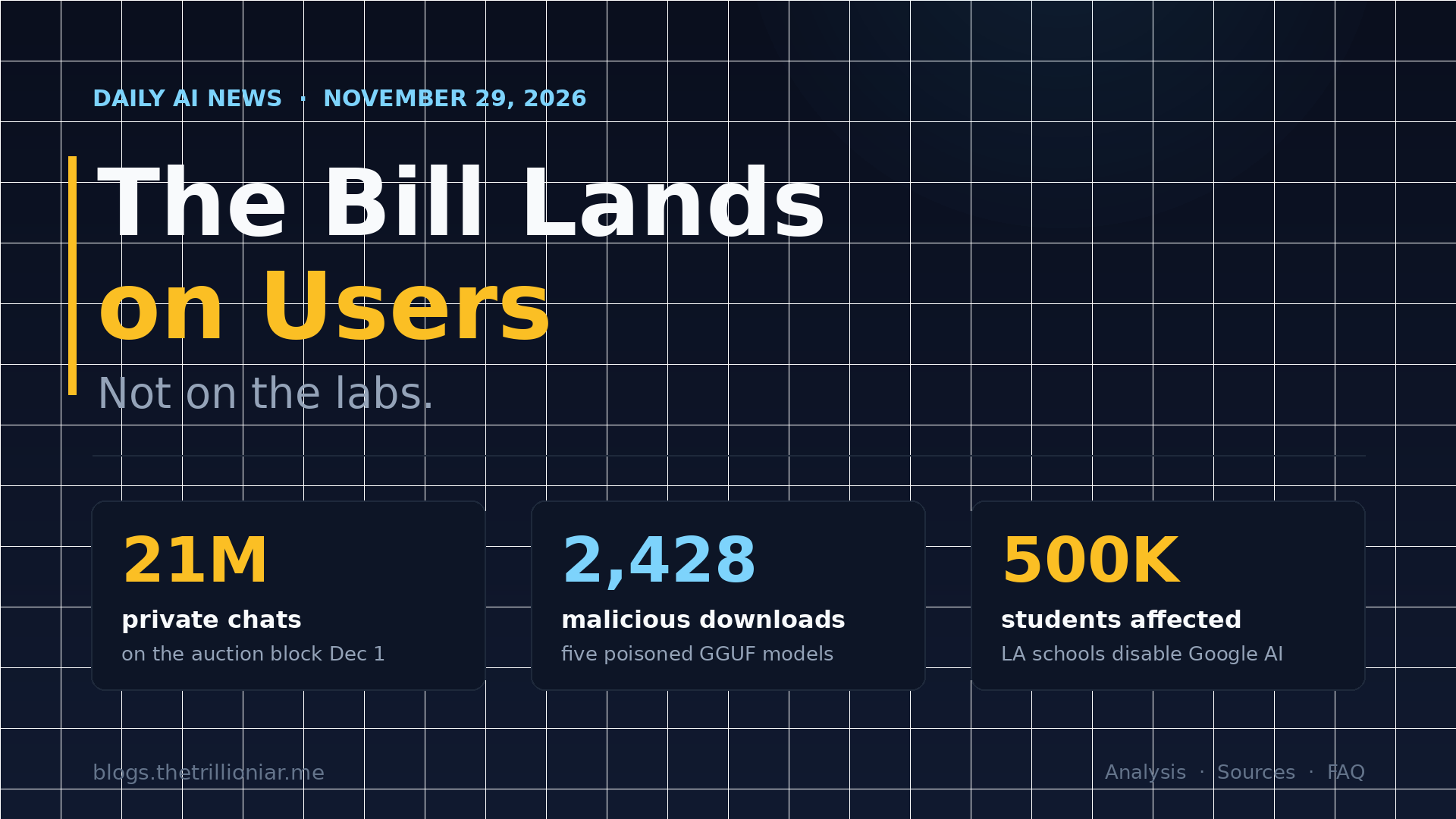
Twenty-one million conversations, 2,428 malicious downloads, and 500,000 students. Each number describes a cost that arrived at the user's end of the system.
What to Watch Next
Watch the December 1 Character.AI auction and the state attorneys general who oppose it. Watch whether Hugging Face removes the five repositories and changes upload checks.
Watch LAUSD's next procurement vote and whether other districts follow. Watch whether Meta and the UK regulators publish actual rules for agent bookings.
Where to Follow This
This briefing runs every day, with a weekly AI news roundup on Mondays and a monthly AI news recap on the first. Yesterday's edition covered the auditors reaching Nvidia's board.