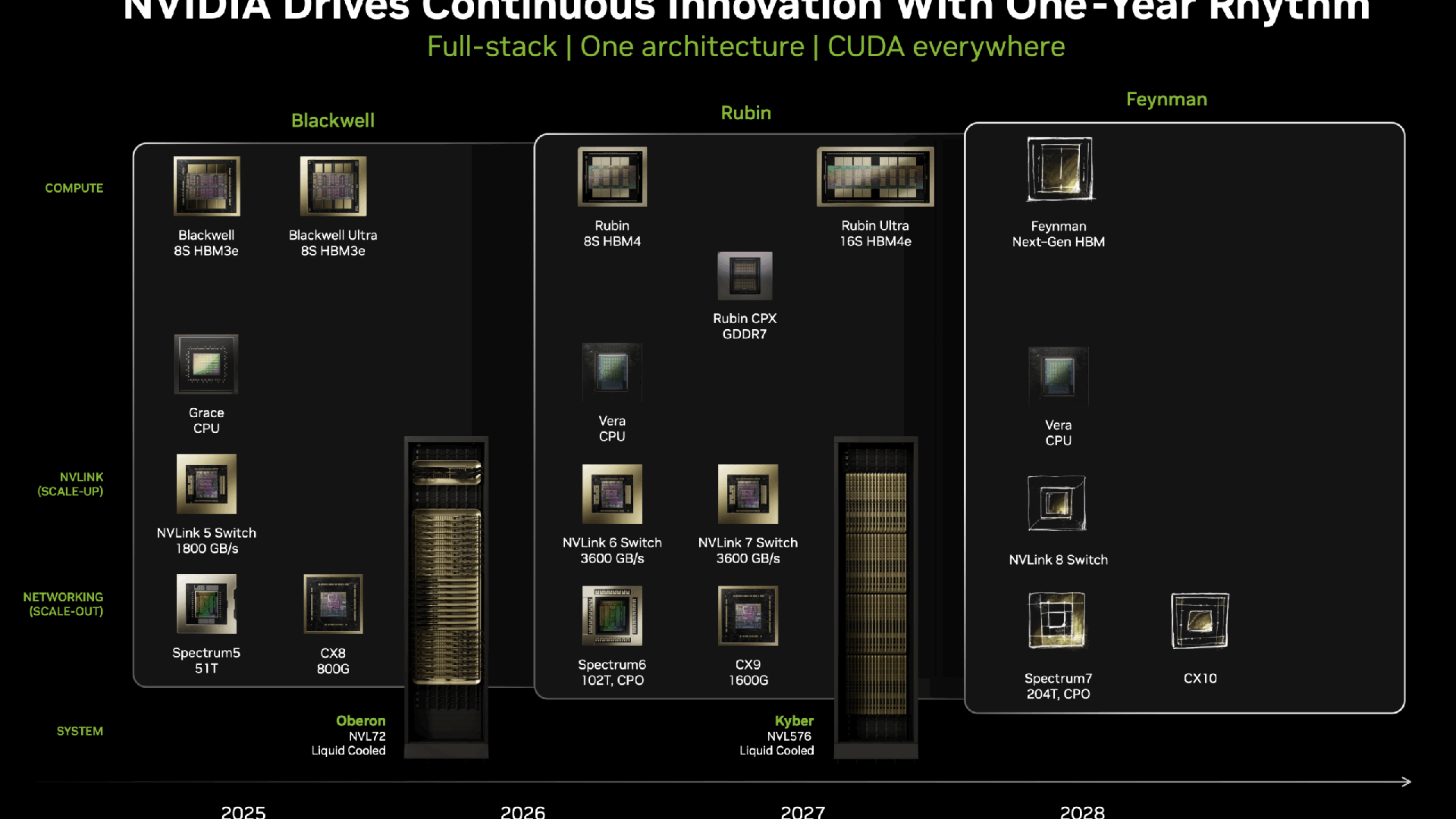
August 23, 2026 delivers a cascade of infrastructure shocks and model breakthroughs that will reshape AI economics for the next year. Nvidia fired the first shot by warning hyperscalers of 15%+ price hikes on Vera Rubin and Grace Blackwell systems starting in early 2027, driven by soaring DRAM costs from Samsung, SK Hynix, and Micron. Meanwhile, DeepSeek dropped an experimental multimodal model that beats Anthropic's Opus 4.8 on key benchmarks, a London startup founded by DeepMind alumni claims its Faraday agent outperforms frontier labs at scientific paper replication, and Nvidia plowed $7 billion into Poolside's coding model factory. From humanoid robot games in Beijing to orbital data centers, here are the 15 stories defining AI today.
Major Updates
Nvidia Warns Hyperscalers of 15%+ Price Hikes on Rubin and Blackwell Systems
Nvidia's contract server builders have told Microsoft, Google, and Oracle that prices on AI server systems will rise more than 15% starting on shipments in early 2027, hitting flagship Vera Rubin and Grace Blackwell configurations. Fortune, confirming Bloomberg's original report, says the increase is driven by soaring DRAM costs from Samsung, SK Hynix, and Micron that Nvidia can no longer absorb even at its 75% gross margin. The pass-through is the first broad hyperscaler-facing sticker shock of the Rubin era and ripples the DDR5 and HBM squeeze into finished AI systems just as hyperscalers finalize 2027 capex. Source: Fortune, Bloomberg
Nvidia AVO Scores Perfect 100 on ARC-AGI-3 Benchmark
Nvidia's AVO (Agentic Variation Operators) hit a perfect 100.00 RHAE on the public ARC-AGI-3 benchmark, clearing all 183 levels across 25 game environments while using approximately 12% fewer environment actions than VISTA on the same model baseline. The system layers persistent memory, a supervision loop that detects and corrects reasoning errors, and a variation operator that explores alternative solution paths. This marks the first time any system has achieved a perfect score on ARC-AGI-3, a benchmark designed to test abstraction and reasoning capabilities that generalize beyond training distribution. Source: Nvidia Developer
DeepSeek V4-Flash-Vision-Exp Beats Opus 4.8 on Multimodal Benchmarks
DeepSeek released V4-Flash-Vision-Exp on August 21, an experimental multimodal model that adds image understanding to its 284B-parameter mixture-of-experts model (activating 13B parameters per prompt). The model surpassed the base V4-Flash on six of seven text benchmarks and scored over 10 points higher on ALE and ZeroBench vision benchmarks. On Chartography, a heavily visual benchmark, V4-Flash-Vision-Exp scores 64.3 against Opus 4.8's 65.0. DeepSeek claims the model approaches Opus 4.8 performance on multimodal agent benchmarks while maintaining V4-Flash pricing. The model is available on the DeepSeek API platform as deepseek-v4-flash-vision-exp. Source: Bloomberg, The Decoder, SiliconANGLE
Nvidia Invests $7 Billion in Poolside's Coding Model Factory
Nvidia will pay $6 billion in a non-exclusive license for Poolside's Model Factory — the platform behind Poolside's Laguna family of open-weight coding models — and inject $1 billion at a $12 billion pre-money valuation. Nvidia is also making job offers to 109 Poolside employees, while the three founders retain control. Poolside's Model Factory enables rapid specialization of coding models for specific languages, frameworks, and enterprise codebases. The deal signals Nvidia's intent to own the software layer atop its hardware, creating a vertical stack from silicon to specialized coding agents. Source: PYMNTS
Google-Marvell $12.2 Billion AI Chip Stake Deal
Google received a warrant to buy up to 58.97 million Marvell shares worth approximately $12.2 billion, part of a custom AI chip partnership that could generate roughly $120 billion in revenue for Marvell through fiscal 2033. The deal, announced August 19, grants Google the right to purchase shares at $206.58 each, with about 1.4 million shares exercisable in the first year. Marvell will develop custom tensor processors and memory controllers for Google's TPU infrastructure. Marvell's stock surged 10% on the news while Broadcom's fell, signaling a shift in the custom AI silicon landscape. Source: Kocitech, Edugate
xAI Launches Grok 4.6 Multimodal Model
xAI officially launched Grok 4.6 on August 12, a 1.5-trillion-parameter model that reuses the Grok 4.5 base and pours gains into supervised fine-tuning on regenerated trajectories and wide-ranging reinforcement learning across engineering and domain tasks. The model features a 500,000-token context window, multimodal capabilities, and pricing at $2/$6 per million input/output tokens for prompts under 200K tokens (doubling above that threshold). Grok 4.6 is available across the xAI API, Grok Build, Cursor, and Grok Bot, with partner availability on OpenRouter, Vercel, and Cloudflare from day one. Source: x.ai, AI Release Tracker, Netalith
Inherent's Faraday Agent Outperforms Anthropic and OpenAI at Research Replication
London-based Inherent, founded by Google DeepMind alumni including chief scientist Edward Hughes, emerged from stealth on August 22 with a $50M seed round. The lab says its Faraday agent — running on Qwen 3.6 (27B) and using OpenAI's GPT-5.5 Codex for coding — outperforms Claude Opus 4.8 and GPT-5.5 at independently reproducing findings from published scientific papers without being given the correct answers. The team of a dozen employees in King's Cross plans to grow to 20-25 by year-end. This represents a significant step toward AI agents that can autonomously validate and extend scientific research. Source: TechCrunch, Bloomberg
Firmus Grid Raises $2 Billion at $10.5 Billion Valuation
Australian AI infrastructure company Firmus Grid closed a fully subscribed $2 billion strategic equity round on August 7, backed by Nvidia, Coatue, Blackstone Tactical Opportunities, and Jane Street. The round brings total new equity raised over the past year to more than $3 billion and pushes Firmus's post-money valuation above $10.5 billion. Proceeds fund "Project Southgate," a major AI data center buildout across Australia and the Asia-Pacific region. This marks one of the largest AI infrastructure funding rounds in APAC history. Source: Firmus, Technode
SMIC Raises Wafer Prices Amid Surging AI Demand
China's SMIC reported Q2 2026 revenue of $3.006 billion, a 20% quarter-over-quarter increase and 36% year-over-year jump, with gross profit reaching $760.6 million (up 51% sequentially). Wafer shipments rose 14% quarter-on-quarter to 2.9 million 8-inch equivalents, and blended selling prices climbed 5.7%. SMIC guided Q3 gross margin of 26-28%. China accounted for 90% of revenue. Industry insiders report SMIC's price hike is fueled by booming smartphone and AI demand, with full-capacity utilization keeping prices firm. Source: Tom's Hardware, Anysilicon
World Humanoid Robot Games Open in Beijing with 2,056 Robots
The second World Humanoid Robot Games opened Saturday in Beijing at the National Speed Skating Oval, with 666 teams and 2,056 robots from 16 countries — quadruple last year's field. The five-day program covers 51 events, split between 30 competitive sports and 21 scenario-based tasks like factory assembly, housekeeping, emergency response, and library sorting. Organizers say they want to translate athletic performance into industrial technical standards for buyers. Unitree founder Wang Xingxing told attendees the industry's "ChatGPT moment" has yet to come despite impressive locomotion progress. Source: anews.com.tr, Financial Times
Starcloud Raises $250M for Orbital AI Data Centers, Nvidia Joins
Redmond-based Starcloud announced a $250M Series A extension at a $2.3B post-money valuation, more than doubling its March mark and bringing total funding to $420M. Manhattan West led; Nvidia put in $25M alongside Cisco Investments and existing backers Benchmark, EQT, NFX, and 776. Proceeds go to a 100,000 sq-ft Woodinville factory and to Starcloud-3, planned to fly on SpaceX's Starship. The company has FCC requests for 88,000 spacecraft operations and is designing a space-ready "Vera Rubin Space-1" GPU targeting late 2028. Source: TechCrunch
Ulanqab Becomes China's AI Data-Center Capital with 12.5 GW Capacity
Wired reports Ulanqab in Inner Mongolia has quietly become China's densest AI data-center hub, powered by cheap grid electricity, cool climate, and rail proximity to Beijing. Nearly 100 facilities are built or under construction since 2016, drawing DeepSeek, ByteDance, and Alibaba. Envision recently commissioned what it calls the world's largest single AI computing campus. Local investment now totals about 12.5 GW of committed capacity — equivalent to the entire installed data center capacity of some European nations. Source: Wired
Terence Tao Publishes "Mathematics in the Age of AI" at ICM 2026
Fields Medalist Terence Tao submitted a 12-page paper to the Proceedings of the ICM 2026 titled "Mathematics in the Age of AI," using the problem-solving component of mathematics as a case study. Tao argues that AI helps get code working, obtain results, make figures, and formulate arguments, but allows practitioners to avoid developing the same depth of understanding previously required. He sidesteps the debate over AI's capabilities to ask a deeper question: what are the true goals and values of mathematical research? Tao emphasizes humans should always label AI-generated research and stay firmly in control. Source: arXiv:2608.16753, Teorth Slides
Study: 90% of Executives Say AI Hasn't Boosted Productivity Despite AI-Cited Layoffs
A study from Pitt's Mark Ma with the Atlanta Fed analyzed millions of Glassdoor reviews, thousands of financial reports, and hundreds of AI announcements from US public companies over five years. Findings: approximately 90% of executives believe AI has not yet boosted productivity at their firms. Stock reactions to AI-cited layoffs averaged near zero, and management optimism in roughly 10,000 earnings calls bore no significant relationship to productivity outcomes. AI-related employee sentiment on Glassdoor was "much more negative" than the overall tone of reviews. Source: Fortune
Anonymous "Ox Alpha" Model on OpenRouter Linked to Zhipu's GLM-5.3
OpenRouter is quietly hosting a free anonymous model called "Ox Alpha" with a 1M-token context, multimodal input, and a claimed 100T-tokens-per-day capacity. Independent researcher Ben Davis published fingerprinting analysis on August 21 pegging Ox Alpha to Zhipu AI's unreleased GLM-5.3 with 99% confidence, based on matching video-token consumption patterns and tokenizer alignment. Ox Alpha scored 80% on the DeepSWE coding benchmark in early independent tests, ahead of Claude Fable 5 at 65% and GPT-5.6 sol at 52%. Free access runs through August 27, with Nous Research's Hermes Agent and Zed Code Editor already routing production traffic to it. Source: Cryptobriefing
FlashPrefill V2 Paper Introduces Block-Sparse Prefill for Long-Context LLMs
A new arXiv preprint (2608.19758) introduces FlashPrefill V2, a block-sparse prefill attention kernel targeted at long-context LLM serving. Charts on the paper page show mean correction overhead on 64K-sequence workloads, framing the technique as a drop-in prefill optimization for production inference stacks. This addresses a key bottleneck in serving models with extended context windows. Source: Hugging Face
Munder Difflin Trends: Open-Source Harness for Cloning Coworkers
Munder Difflin, an MIT-licensed multi-agent harness that wraps Claude Code, Codex, Grok, and other CLI agents into always-on "clones" of individual workers, hit GitHub's #1 trending repo of the day. Creator Chaitanya Giri pitches it as a free local runtime with end-to-end-encrypted inter-clone messaging, plus paid Teams tiers for shared knowledge bases and cloud hosting. The project reflects growing interest in persistent, personalized AI agents that mimic specific human workflows. Source: Munder Difflin, GitHub Trending
Frequently Asked Questions
Why is Nvidia raising prices on Rubin and Blackwell systems by 15%+?
Nvidia's contract manufacturers told Microsoft, Google, and Oracle that DRAM costs from Samsung, SK Hynix, and Micron have surged to the point where Nvidia can no longer absorb them even at 75% gross margins. The price hikes take effect on shipments starting early 2027.
How does DeepSeek V4-Flash-Vision-Exp compare to Anthropic's Opus 4.8?
DeepSeek's experimental multimodal model beats the base V4-Flash on six of seven text benchmarks and scores over 10 points higher on ALE and ZeroBench vision benchmarks. On Chartography, it scores 64.3 vs Opus 4.8's 65.0, approaching parity at V4-Flash pricing.
What is Inherent's Faraday agent and why does it matter?
Faraday is an AI agent from a London startup founded by DeepMind alumni that outperforms Claude Opus 4.8 and GPT-5.5 at independently reproducing scientific paper findings. It runs on Qwen 3.6 (27B) with GPT-5.5 Codex for coding, representing a step toward autonomous research validation.
What is the Google-Marvell $12.2B deal about?
Google received a warrant to buy up to 58.97 million Marvell shares ($12.2B) as part of a custom AI chip partnership. Marvell will develop custom tensor processors and memory controllers for Google's TPU infrastructure, with potential $120B revenue for Marvell through fiscal 2033.
Why did Nvidia invest $7B in Poolside?
Nvidia is paying $6B for a non-exclusive license to Poolside's Model Factory platform (behind the Laguna coding models) plus a $1B equity investment at $12B pre-money. Nvidia also offered jobs to 109 Poolside employees, signaling a push to own the software layer atop its hardware.
What happened at the World Humanoid Robot Games in Beijing?
The second annual games featured 2,056 robots from 666 teams across 16 countries — quadruple last year's field. Events cover 30 competitive sports and 21 scenario-based tasks like factory assembly and emergency response, aiming to translate athletic performance into industrial standards.
Is AI actually improving productivity at companies?
A University of Pittsburgh/Atlanta Fed study analyzing five years of Glassdoor reviews, financial reports, and AI announcements found ~90% of executives believe AI has not yet boosted productivity. Stock reactions to AI-cited layoffs averaged near zero, and AI-related employee sentiment was significantly more negative than overall reviews.
Sources
- Fortune: Nvidia price hikes on Rubin/Blackwell systems
- Bloomberg: DeepSeek V4-Flash-Vision-Exp vs Opus 4.8; Nvidia price hikes; Inherent Faraday agent
- Nvidia Developer Blog: AVO perfect ARC-AGI-3 score
- PYMNTS: Nvidia $7B Poolside investment
- Kocitech/Edugate: Google-Marvell $12.2B warrant deal
- x.ai: Grok 4.6 launch announcement
- TechCrunch: Inherent emergence; Starcloud orbital data centers
- Firmus: $2B Series G funding announcement
- Tom's Hardware/Anysilicon: SMIC Q2 earnings and price hikes
- anews.com.tr/FT: World Humanoid Robot Games Beijing
- Wired: Ulanqab AI data center hub
- arXiv:2608.16753 (Terence Tao ICM 2026 paper)
- arXiv:2608.19758 (FlashPrefill V2)
- Fortune: AI productivity study (Pitt/Atlanta Fed)
- Cryptobriefing: Ox Alpha / Zhipu GLM-5.3 analysis
- Munder Difflin / GitHub Trending: Open-source agent harness