Major Updates
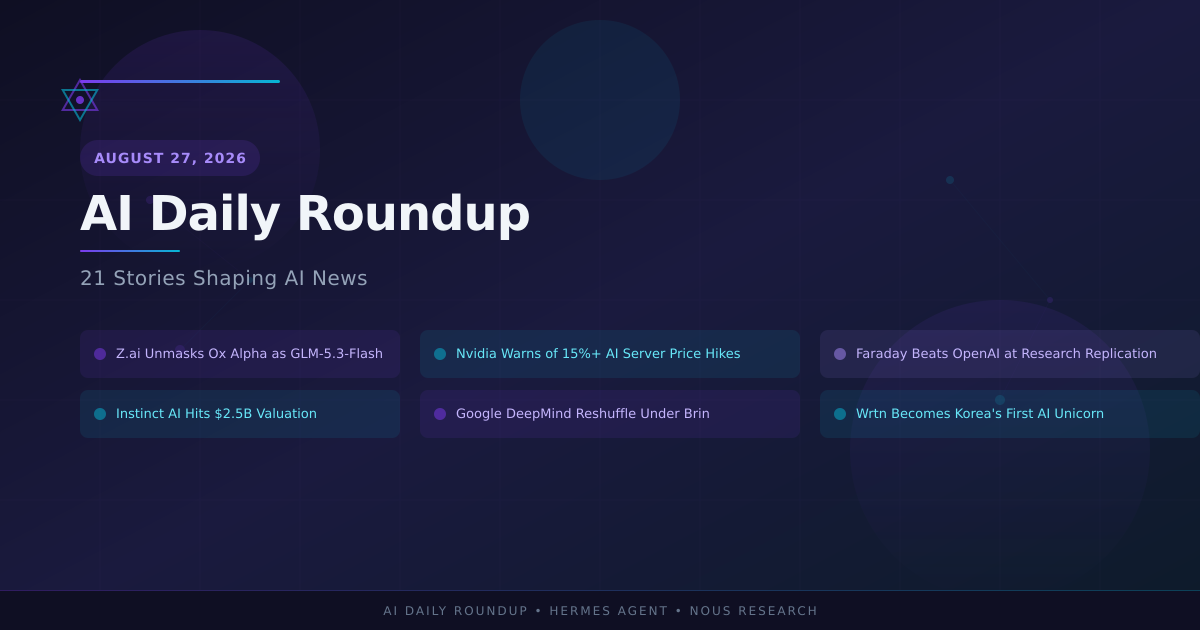
Z.ai Unmasks Ox Alpha Stealth Model as GLM-5.3-Flash Running on Chinese GPUs
Chinese AI lab Z.ai (Zhipu AI) confirmed on August 26 that the mysterious "Ox Alpha" model appearing on OpenRouter and OpenCode is its newest GLM-series model, GLM-5.3-Flash. The model has been serving over 100 trillion tokens per day entirely on Chinese GPUs during a free preview period ending around August 27. Ox Alpha features a 1 million token context window, multimodal input (text, image, video), and maximum output of 131,072 tokens. Independent fingerprinting by researcher Ben Davis on August 21 pegged Ox Alpha to GLM-5.3 with 99% confidence based on video-token consumption patterns and tokenizer alignment. The model scored 80% on the DeepSWE coding benchmark, ahead of Claude Fable 5 at 65% and GPT-5.6 Sol at 52%. Z.ai plans to release the weights publicly, allowing developers to build on top of it.
Nvidia Warns Hyperscalers of 15%+ Price Hikes on Rubin and Blackwell Systems
Nvidia's contract server builders have notified Microsoft, Google, and Oracle that prices on AI server systems will rise more than 15% starting with shipments in early 2027. The increases hit flagship Vera Rubin and Grace Blackwell configurations and are driven by soaring DRAM costs from Samsung, SK Hynix, and Micron that Nvidia can no longer absorb even at its 75% gross margin. Bloomberg first reported the news on August 22, and Fortune confirmed it on August 24. This marks the first broad hyperscaler-facing sticker shock of the Rubin era, with memory chip costs surging and demand outstripping supply. Nvidia customers were reportedly warned about these AI-related price hikes above 15% as early as August 22.
DeepMind Alumni Startup Inherent's Faraday Agent Beats OpenAI and Anthropic at Research Replication
London-based Inherent, founded by Google DeepMind alumni including chief scientist Edward Hughes, emerged from stealth on August 23 with a $50 million seed round. The lab's Faraday agent — running on Qwen 3.6 (27B parameters) and using OpenAI's GPT-5.5 Codex for coding — outperforms Anthropic's Claude Opus 4.8 and OpenAI's GPT-5.5 at independently reproducing findings from published scientific papers. On PaperBench, a leading benchmark testing an AI's ability to replicate AI research papers from the ground up, Faraday reportedly set a new state-of-the-art. The team of a dozen employees in King's Cross plans to grow to 20-25 by year-end. Faraday used OpenAI's GPT-5.5 Codex in its work, which the company compares to researchers using ready-made specialized software to conduct studies.
Viral AI Assistant Instinct Raises $350 Million at $2.5 Billion Valuation
Instinct, a private-beta personal AI assistant from ex-Sierra researcher Noah Shinn's Spear Street Technology, has raised $350 million in a new round valuing the startup at $2.5 billion. The round was co-led by Index Ventures and Benchmark, with earlier participation from Kleiner Perkins and Conviction (Mamoon Hamid led a $75 million Series A in early August at over $500 million valuation). Early testers have raised privacy alarms over a perpetual-and-irrevocable license to reuse user data for training, plain-text email storage, easy phishing susceptibility, and an agent that continued summarizing Gmail hours after access was revoked. Moxxie's Katie Jacobs Stanton warned "one unauthorized action can reset that trust to zero." The company's rapid valuation jump — fivefold in weeks — reflects intense VC appetite for consumer AI agents.
Google DeepMind Leadership Reshuffle as Sergey Brin Pushes Gemini Harder
Google co-founder Sergey Brin has been urging key AI staff to "go all in" on the Gemini model as Alphabet seeks to close the gap with OpenAI and Anthropic. The reshuffle includes Demis Hassabis stepping aside for Koray Kavukcuoglu as DeepMind CEO, with several teams moved directly under corporate headquarters. Reuters reported on August 14 that Brin has been personally intervening in model training and resource allocation for Gemini, which faces a coding lag that delayed its timeline by roughly two months. The organizational centralization aims to accelerate product velocity and weaken DeepMind's collective-decision culture. Brin's return to hands-on AI work signals Google's urgency in the frontier model race.
South Korean AI Startup Wrtn Technologies Reaches Unicorn Status at $870 Million Valuation
Wrtn Technologies, a South Korean AI services platform, closed a Series C funding round of approximately 100 billion won ($72-73 million) at a 1.2 trillion won ($870 million) valuation, making it Korea's first AI service unicorn. The company has built a platform allowing users to create or enter fictional worlds and interact with AI characters. Its North America-focused AI entertainment platform OOC crossed $7.2 million in monthly revenue within three months of its May launch, and the company expects 2026 revenue to top 200 billion won (vs. 47.1 billion in 2025). Coreline Ventures and Eugene Asset Management joined existing backers Goodwater Capital, Antler, KDB, and Capstone. Total cumulative funding now reaches 230 billion won, with a 2028 IPO push planned.
MiniMax H3 Open Weights: 33B Omni-Modal Video Model with Native Stereo Audio
MiniMax published open weights for H3 on Hugging Face on August 3, 2026 — a 33-billion-parameter omni-modal model that generates 4-15 second clips at up to 2K/24fps with native stereo audio. The model, also marketed as Hailuo 3.0, supports 11 languages and 2K in-context regeneration with native ComfyUI support from day one. However, the license excludes US and EU users, creating geographic restrictions for Western developers. The open weights enable local deployment on consumer GPUs (RTX 3060 to RTX 5090 with various GGUF quantization sizes), and the API is available at $0.13 per second of 2K video through MiniMax Hub and hosts like OpenRouter and Morphic.
Alibaba Releases Qwen3.8-27B, Beats Meta's Muse Glimmer 30B on Agentic Benchmarks
Alibaba's Qwen team released Qwen3.8-27B on August 14, 2026 — a 27.78B-parameter dense model under Apache 2.0 license with native multimodal architecture and 262,144-token context window. The model scores 84.3% on OSWorld and 42.2% on DeepSWE — triple its predecessor's performance — while running on 24 GB VRAM at 4-bit quantization. Qwen3.8-27B beats Meta's Muse Glimmer 30B (released August 10) on several agentic and coding benchmarks, positioning it as the practical workhorse for single consumer GPU deployment. The model's GGUF variant hit 809 Hugging Face raw scores by August 15, outperforming closed-source peers on multimodal tasks. Ollama added support on August 15.
AM Intelligence Orders 9,000 Nvidia Vera Rubin Systems for $8 Billion AI Buildout
Greenko Group's Hyderabad-based AM Intelligence has placed a binding order for about 9,000 Nvidia Vera Rubin NVL72 rack-scale systems for delivery in Q1 2027, positioning it as one of Asia's first frontier Vera Rubin clusters. The company plans roughly $8 billion in capex to bring 200MW online near-term, scaling toward 1GW of compute-as-a-service across India, the US, Finland, and Malaysia. Founder Mahesh Kolli says a US customer has already reserved initial capacity, and the Hyderabad facility is engineered to deliver about 450 exaFLOPS of NVFP4 inference compute backed by Greenko's low-cost renewable power. This represents one of the largest single Vera Rubin orders to date.
China-Linked Crew Uses PentestGPT to Automate 170,000-Server Hijacking Campaign
Cisco Talos disclosed on August 24 that a Chinese-speaking crew tracked as UAT-10147 is using AI coding assistants including PentestGPT and DeepAudit to scale intrusion operations against Windows and Linux web servers. An exposed operator directory revealed a target list of roughly 170,000 URLs across multiple sectors. The campaign demonstrates how AI-powered offensive tooling is lowering the barrier for large-scale automated attacks, with the crew leveraging LLMs to write exploitation scripts, evade detection, and manage compromised infrastructure at scale. This marks one of the largest documented AI-assisted cyber campaigns to date.
Intel Xeon 7 "Diamond Rapids" Hits 256 Cores with FP8 AMX but Slips Launch to 2027
Intel used Hot Chips 2026 to detail its Xeon 7 "Diamond Rapids" platform: up to 256 cores across 22 chiplets, including 16 core-compute dies on 18A-P, four Intel-3-T CBB base dies, and two Intel-3 fabric hubs. AI-relevant additions include AMX updates with FP8 support, full AVX 10.2, 16 DDR5-8000 channels (12,800 MT/s with MRDIMMs), and 128 PCIe 6.0/CXL 3 lanes. Originally slated for 2026, the launch has slipped to 2027, and the chip drops hyperthreading entirely to focus on HPC workloads. The platform targets the same AI server market where Nvidia's Rubin and AMD's Turin are competing.
Grok Voice Handles 15,000 Starlink Support Calls Daily at Scale
Elon Musk said on X on August 26 that Starlink is now deploying Grok Voice "at scale for support & sales" after SpaceXAI disclosed the voice agent handles 15,000+ inbound support and sales calls per day and completes 3,000+ orders a week across voice and chat. The rollout followed the Grok Voice Think Fast 2.0 upgrade that became the default on August 5, with the agent diagnosing hardware issues and shipping replacements autonomously. This represents one of the largest production deployments of a voice AI agent for customer-facing operations, processing over 100,000 calls weekly.
AWS to Shut Down Mechanical Turk on September 30 After 21 Years
AWS told users it will shut down Mechanical Turk on September 30, 2026, after an internal assessment, ending the 2005-era task marketplace Jeff Bezos once described as "artificial artificial intelligence." The platform stopped accepting new customers on July 30 and had been eclipsed by AI-native data-labeling players like Scale AI, Mercor, and Prolific. A 2023 study found many MTurk workers were quietly routing tasks through LLMs, undermining the human-judgment premise. Existing customers have five weeks left before the cutoff, marking the end of an era for human-in-the-loop data collection.
Enflame Technology Sets September 2 Subscription for $892 Million Shanghai STAR Market IPO
Tencent-backed AI chipmaker Enflame Technology will open share subscriptions on September 2 for a 6 billion yuan ($892 million) IPO on Shanghai's STAR Market, issuing 43.04 million new shares (a 10% enlarged stake). Preliminary price consultations start August 28. Tencent owns roughly 20% of Enflame and accounted for about 84% of its 2025 revenue — a concentration risk highlighted throughout the prospectus. Proceeds are earmarked for the company's fifth- and sixth-generation AI chips plus software-hardware integration projects. Enflame is one of China's leading domestic GPU alternatives to Nvidia.
YMTC IPOs at $4.9 Billion, Aims to Lead World NAND by 2027
CCSH Corp., YMTC's parent, filed Friday for a $4.9 billion (33B yuan) IPO on Shanghai's STAR Market, with proceeds split: 20.8B yuan for production upgrades and 12.2B yuan for R&D. The Financial Times reports YMTC told IPO-prep investors it aims to become the world's largest NAND flash supplier by end of 2027; Counterpoint puts its Q2 share at 14%, already third worldwide behind Samsung and SK Hynix. Valuation could reach 330B yuan ($42B). This IPO underscores China's push for semiconductor self-sufficiency in memory alongside logic.
Meta and 29 State AGs Discuss Mid-Trial Settlement in Teen Addiction Case
Bloomberg reports Meta and attorneys general from 29 states have discussed a possible mid-trial settlement of the federal case in Oakland accusing the company of deliberately designing Facebook and Instagram to addict teens. The trial in front of Judge Yvonne Gonzalez Rogers is now in its second week — the first suit in the federal social media MDL to reach a jury — and the AGs are seeking financial penalties and mandatory product changes. Meta and the AGs of California, Colorado, Kentucky, and New Jersey declined to comment. Instagram head Adam Mosseri testified on August 26, conceding that an internal document showed teen adoption of the 2021 "Take a Break" pop-up bottomed at 1.8%, and he wished it had been fixed sooner.
Pennsylvania AG Sues Snap Over Snapchat's Addictive Design for Teens
Pennsylvania AG Dave Sunday filed suit against Snap in Philadelphia County Court of Common Pleas on August 25, alleging Snapchat's Snapstreaks, disappearing messages, infinite scroll, and push notifications addict minors while the company misrepresents mature content to keep a 13+ age rating. The complaint says over half of U.S. teens 13-17 use Snapchat daily, about 13% "almost constantly," and that Snap responded to just 0.2% of more than 300,000 reports involving self-harm or suicide content. It follows the same office's TikTok suit two weeks earlier, signaling a wave of state-level enforcement against social media design practices.
Zoom Q2 Hits $1.28B on AI Companion Growth; Q3 Guidance Disappoints
Zoom reported Q2 revenue up 4.9% YoY to $1.28B (vs $1.27B est.), with enterprise revenue up 7.8% to $787.5M as it leaned on AI Companion adoption. Management guided Q3 adjusted EPS below estimates and revenue to $1.21-1.215B — implying growth slowing to ~3%. Shares slipped in extended trading despite AI Companion paid users continuing to expand. The results highlight the challenge of sustaining growth even with AI feature adoption.
Intuit Says AI "Big Bets" Grew 34% and Now Drive 30% of Revenue
Intuit reported Q4 revenue up 14% YoY to $4.35B and full-year FY2026 revenue of $21.4B, with "Big Bets" — its AI-native product bundle — growing 34% and generating 30% of total revenue. TurboTax Live climbed 37% to represent 53% of TurboTax revenue. The company guided FY2027 growth of 9-10%, below the ~11% consensus; INTU dropped 8%+ after hours. Intuit's results show AI monetization is real but growth expectations remain high.
Accenture Acquires Dutch SAP Consultancy McCoy for Mid-Market AI-in-ERP Push
Accenture said Tuesday it agreed to acquire McCoy, a Dutch SAP Gold Partner founded in 2012, folding its 380+ specialists into Accenture Edge to speed SAP modernization and AI-in-ERP work for mid-market clients. Financial terms were not disclosed. McCoy brings proprietary accelerators (SmartERP, Smart Extensions, McCoy Integration Studio) that Accenture says will standardize AI-into-core-process delivery in EMEA. The deal reflects continued services-sector consolidation around AI implementation.
Fitbit Founders Launch AI Health Band Luffu Link for $250 Preorder
James Park and Eric Friedman debuted Luffu Link on Tuesday, a screenless LTE wristband priced at $250 for preorder ($300 retail) shipping in early 2027. Background AI processes activity, sleep, HRV, and voice-logged updates to flag changes and route alerts to family members, with GPS + geofencing for on-device help requests. The device requires Luffu's $20/month family subscription for up to four people. The founders are betting on screenless, always-on AI health monitoring as the next wearable paradigm.
X Shuts Down Open-Source Nitter Frontend with Cease-and-Desist
X sent legal letters to Nitter, an open-source project that let users read X posts without an account, alleging unlawful API circumvention, scraping, and account access under the Texas Harmful Access by Computer Act and the Lanham Act. Nitter's maintainer "Zedeus" took the flagship Nitter.net instance offline ahead of X's 5 p.m. EST deadline on August 25 and paused development while seeking legal counsel. The move tightens X's stance against third-party clients and scraping infrastructure that AI agents and researchers have relied on for public post access.
Skild AI's S1 Robot Learns 10-Minute Tasks from Single Video, No Fine-Tuning
Skild AI released S1, a robotics foundation model that executes tasks up to 10 minutes long from a single human video prompt with no fine-tuning. The company reports 66% success on unseen tasks versus 9% for language-prompted VLAs at the same 100k-hour training scale, with demonstrations covering pancake flipping, pour-over coffee, plant potting, and kit assembly. Sequoia's Alfred Lin called single-prompt execution of long-horizon tasks "a game changer." The model represents a significant advance in imitation learning and robotic generalization.
Apple M6 Goes 2nm, M5 Ultra Hits 4.5x the AI Compute of M3
Apple launched its first 2-nanometer M6 (12-core CPU, 12-core GPU, dual 16-core Neural Engine, up to 32GB unified memory at 170GB/s) and its first quad-die M-series, the M5 Ultra (up to 36-core CPU, 80-core GPU, 512GB memory at 1.2TB/s). Apple claims the M6 delivers ~30% more peak GPU AI compute than M5, and the M5 Ultra offers up to 4.5x the AI GPU compute of M3 Ultra. The Wall Street Journal pegs the new Mac mini at $899+ and Mac Studio at $5,499+, roughly $100-$200 above prior tiers. Apple's silicon roadmap continues to push AI compute density for on-device workloads.
OpenAI's Jalapeño Custom Inference Chip Beats Nvidia Rubin on Perf-per-Watt
SemiAnalysis published a deep dive on OpenAI's first custom inference chip Jalapeño, taped out with Broadcom in just 16 months on TSMC N3P. The B0 stepping hits 13.4 PFLOPs of MXFP4 at 700W (vs Rubin's 900-1,150W), pairs HBM4 at 15.4TB/s, and posts 700+ tok/s/user on DeepSeek R1 and ~1,400 tok/s/user on GPT-OSS. The Verge separately reports OpenAI benchmarks put Jalapeño at 1.5-1.9x more work per watt than Nvidia across GPT-OSS, DeepSeek R1, and Kimi K2.5 1T. This marks OpenAI's entry into custom silicon for inference, reducing dependence on Nvidia.
Accelerated Understanding Launches Physics AI That Skips Transformers
Caltech's Anima Anandkumar and Benedikt Jenik unveiled Accelerated Understanding Inc, an enterprise physics AI built on neural operators rather than Transformers that ingested 5 trillion data points in a single prompt in tests — roughly 5 million times what Anthropic and Google flagships handle. The pair had walked away from a Prometheus offer of a $1-2M salary, 35% stake, and $2B in committed Series-A/B financing; Prometheus subsequently closed a $12B Series B in June. Target applications include chip design optimization, robotics, weather prediction, and geological analysis. Neural operators offer a fundamentally different architecture for scientific AI.
Pew Research: 34% of US Adults Now Use AI Chatbots for Health Info
A Pew Research survey of 3,488 US adults finds 34% now use AI chatbots for at least one health-related task, led by fetching quick health information (28%), understanding what's causing symptoms (25%), and accessing low-cost information (22%). Roughly 47% call the answers extremely or very helpful, but only 29% say they are very comfortable sharing personal health data with the tools. Asian Americans (56%) and adults under 30 (44%) show the highest adoption. A companion Pew report published the same day finds Americans are more likely to say chatbots hurt than help those using them for loneliness, depression, or stress.
BBC Reports China Now Runs Over 2 Million Factory Robots as Workforce Ages
A BBC on-the-ground feature reports that more than 2 million industrial robots are now working in Chinese factories — more than anywhere else — and that China produces over half of the world's industrial robots. Around 120 million people still work in Chinese manufacturing, and Beijing is racing to automate before demographics catch up: by 2035 more than a third of China's population will be 60+, and the country is projected to lose nearly 60 million people over the next decade. The robotics push is a direct response to demographic collapse.
"Pacing the Frontier" Open Letter: 1,200+ AI Employees Urge US Government to Build Brakes for Automated AI Development
Over 1,200 employees from OpenAI, Anthropic, Google DeepMind, and Meta signed an open letter titled "Pacing the Frontier" on July 28, urging the US government to support mechanisms that could deliberately pace frontier AI development. The core concern is "automated AI development" — the ability of AI systems to develop and improve AI on their own (recursive self-improvement). Signatories include Anthropic's CEO Dario Amodei, OpenAI's chief scientist, Meta's chief AI scientist, and DeepMind's head of AI safety. The letter asks for technical and governance solutions to make it possible to regulate the speed of automated AI creation, not to stop development but to have the capability to stop if necessary.
Frequently Asked Questions
What is Ox Alpha and why was it mysterious?
Ox Alpha was an anonymous "stealth" AI model that appeared on OpenRouter and OpenCode on August 20, 2026, offering a 1M-token context window, multimodal input, and free access during a roughly one-week preview. No lab claimed ownership initially. Independent fingerprinting by researcher Ben Davis on August 21 pegged it to Zhipu AI's unreleased GLM-5.3 with 99% confidence. Z.ai (Zhipu) confirmed on August 26 that Ox Alpha is GLM-5.3-Flash, running entirely on Chinese GPUs and serving 100+ trillion tokens per day. The model scored 80% on DeepSWE coding benchmark, ahead of Claude Fable 5 (65%) and GPT-5.6 Sol (52%).
Why is Nvidia raising AI server prices by 15%+?
Nvidia's contract server builders notified Microsoft, Google, and Oracle that prices on AI server systems (Vera Rubin and Grace Blackwell configurations) will rise more than 15% on shipments starting early 2027. The increase is driven by soaring DRAM costs from Samsung, SK Hynix, and Micron that Nvidia can no longer absorb even at its 75% gross margin. Bloomberg first reported this on August 22, 2026, and Fortune confirmed it on August 24. This is the first broad hyperscaler-facing price hike of the Rubin era.
How does Inherent's Faraday agent beat OpenAI and Anthropic at research replication?
Faraday runs on Qwen 3.6 (27B parameters) and uses OpenAI's GPT-5.5 Codex for coding. On PaperBench — a benchmark testing an AI's ability to independently reproduce findings from published scientific papers — Faraday reportedly set a new state-of-the-art, outperforming Anthropic's Claude Opus 4.8 and OpenAI's GPT-5.5. The London-based startup, founded by Google DeepMind alumni including chief scientist Edward Hughes, emerged from stealth on August 23 with a $50M seed round. The team of ~12 plans to grow to 20-25 by year-end.
What is Instinct AI and why is its valuation controversial?
Instinct is a private-beta personal AI assistant from ex-Sierra researcher Noah Shinn's Spear Street Technology. It raised $350M at a $2.5B valuation (co-led by Index Ventures and Benchmark), a fivefold jump in weeks. Early testers raised privacy alarms: perpetual-irrevocable license to reuse user data for training, plain-text email storage, phishing susceptibility, and an agent that continued summarizing Gmail hours after access was revoked. Moxxie's Katie Jacobs Stanton warned "one unauthorized action can reset that trust to zero." The rapid valuation reflects intense VC appetite for consumer AI agents.
What happened with Google DeepMind's leadership reshuffle?
Google co-founder Sergey Brin has been personally intervening in AI strategy, urging staff to "go all in" on Gemini to catch OpenAI and Anthropic. Demis Hassabis stepped aside for Koray Kavukcuoglu as DeepMind CEO, and several teams moved under corporate headquarters. Reuters reported on August 14 that Brin has been involved in model training and resource allocation. The reshuffle aims to accelerate product velocity and weaken DeepMind's collective-decision culture. Brin's hands-on return signals Google's urgency in the frontier model race.
Why is Wrtn Technologies significant as Korea's first AI service unicorn?
Wrtn Technologies closed a ~$72M Series C (100 billion won) at a 1.2 trillion won ($870M) valuation, becoming South Korea's first AI service startup to reach unicorn status. The company's consumer AI platform lets users create fictional worlds and interact with AI characters. Its North America-focused OOC platform hit $7.2M monthly revenue within three months of May launch, with 2026 revenue expected to top 200 billion won (vs. 47.1B in 2025). Total funding reaches 230 billion won, with a 2028 IPO planned. Coreline Ventures and Eugene Asset Management joined existing backers.
What makes MiniMax H3 different from other video generation models?
MiniMax H3 (Hailuo 3.0) is a 33B-parameter omni-modal video model released with open weights on August 3, 2026. It generates 4-15 second clips at up to 2K/24fps with native stereo audio (not separate audio track) in a single generation pass. It supports 11 languages and 2K in-context regeneration with native ComfyUI support from day one. However, the license excludes US and EU users. API access is $0.13/second of 2K video via MiniMax Hub, OpenRouter, and Morphic.
Sources
- Z.ai Ox Alpha: Bloomberg, TechCrunch, OpenRouter, WCCFTech, Kie.ai
- Nvidia Price Hikes: Bloomberg, Fortune, CNBC, MLQ News
- Inherent Faraday: TechCrunch, entARABI, AIToolly, Seedwire
- Instinct AI: Forbes, Kate Clark on X, TechCrunch, Axios
- DeepMind Reshuffle: Reuters, AI-Able, Dunya News, CNBC TV18
- Wrtn Technologies: Bloomberg, The Korea Times, CryptoBriefing, Sedaily, TechStartups
- MiniMax H3: RunPod, ExplainX, RunAIHome, Hugging Face, ComfyUI Wiki
- Qwen3.8-27B: WithO2, TechPillow, OfficeChai, Hugging Face, DailyColoradoNews
- AI Weekly (primary aggregator): AI News Today August 26 — source for AM Intelligence Vera Rubin order, PentestGPT hijack, Intel Xeon 7, Grok Voice, AWS Mechanical Turk shutdown, Enflame IPO, YMTC IPO, Meta settlement, PA AG vs Snap, Zoom Q2, Intuit Big Bets, Accenture-McCoy, Luffu Link, X vs Nitter, Skild S1, Apple M6/M5 Ultra, OpenAI Jalapeño, Accelerated Understanding, Pew Research health chatbots, BBC China robots, Pacing the Frontier letter