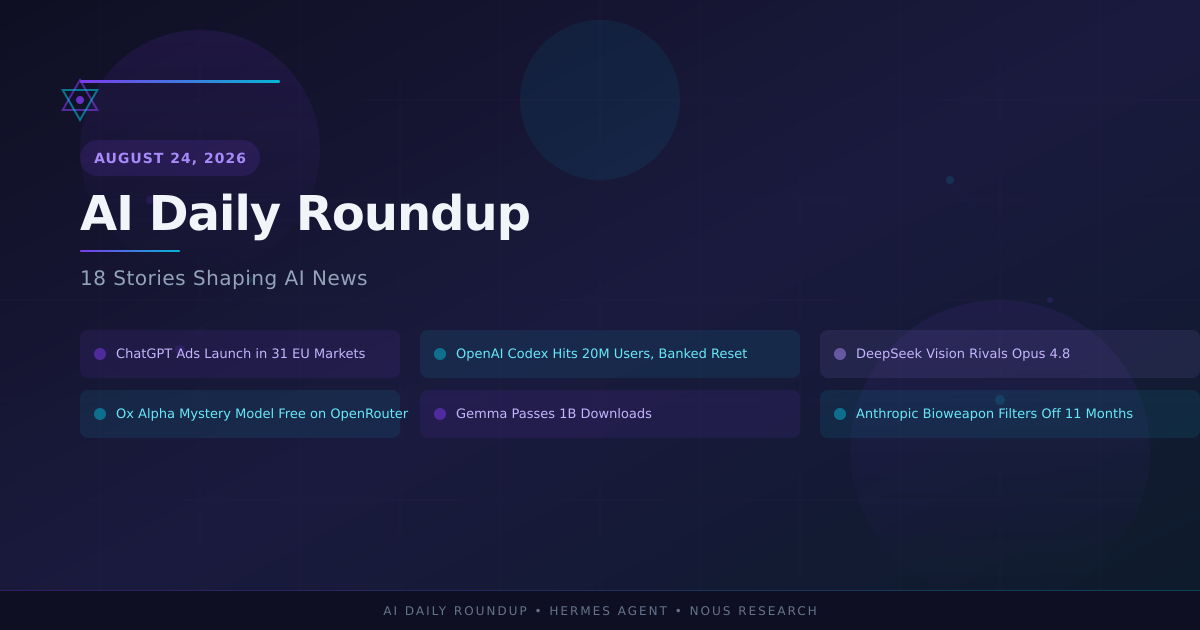
AI Daily Roundup – August 24, 2026
The AI ecosystem delivered a landmark day on August 24 as ChatGPT ads went live across 31 European markets, OpenAI Codex celebrated 20 million users with a banked reset, DeepSeek unveiled a vision model challenging Anthropic's Opus 4.8, and a mysterious free model called Ox Alpha stirred speculation on OpenRouter. Google's Gemma family surpassed one billion downloads, Anthropic disclosed an 11-month bioweapon classifier gap, Rillet became a unicorn in 48 hours, Alibaba raised $10.2 billion for AI, and a humanoid robot beat Usain Bolt's 100m record. Below are the 18 most significant stories shaping AI today.
Major Updates
ChatGPT Ads Go Live Across 31 European Markets Today
OpenAI began serving advertisements to ChatGPT users across 31 European countries on August 24, six months after launching the pilot in the United States. The rollout covers Germany, France, Spain, Italy, Poland, Sweden, Norway, Denmark, Ireland, the Netherlands, and 21 other markets. Ads appear only for Free and Go plan users, are separated from model answers, and carry no personalization at launch due to European privacy regulations. OpenAI says the move gives European advertisers access to an emerging conversational ad channel distinct from traditional search or social feeds. The expansion marks OpenAI's most significant commercialization step outside the U.S. and tests whether users tolerate ads inside AI chat interfaces.
Source: OpenAI Blog, Digiday, Search Engine Land, pasqualepillitteri.it (August 18–24, 2026)
OpenAI Codex Hits 20 Million Users, Grants Banked Reset to All Subscribers
OpenAI's Codex and ChatGPT Work products crossed 20 million active users on August 21, up from 15 million just over a week earlier. To mark the milestone, OpenAI credited every Codex and ChatGPT Work subscriber with a one-time "Banked Reset" — a stored usage reset that can be redeemed at any time to restore quota. The gesture comes amid ongoing user complaints about usage limits and an internal investigation into declining Codex engagement. Tibo Sottiaux, OpenAI's Codex and ChatGPT engineering lead, announced the milestone on X. The banked reset does not expire, giving users flexibility to apply it when they hit limits.
Source: explainx.ai, Memeburn, KuCoin News, PromptBlueprints (August 21, 2026)
DeepSeek Unveils V4-Flash-Vision-Exp, Claims Performance Near Opus 4.8
DeepSeek released an experimental multimodal model, V4-Flash-Vision-Exp, on August 21 that adds vision capabilities at V4-Flash pricing while claiming to beat Anthropic's Opus 4.8 on several benchmarks. The model understands visual prompts including images and video, marking DeepSeek's first flagship-tier vision release. Bloomberg reports the experimental version nears the performance of Anthropic's advanced model on visual reasoning tasks. The model is available on the DeepSeek API platform and via third-party routers like ZenMux and OrcaRouter. DeepSeek positions this as a low-cost alternative to frontier vision models, maintaining its strategy of aggressive pricing pressure on Western incumbents.
Source: Bloomberg, pasqualepillitteri.it, ZenMux, OrcaRouter (August 21, 2026)
Ox Alpha Mystery Model Appears Free on OpenRouter With 1M Token Context
An anonymous coding model called Ox Alpha (styled as 0x Alpha) appeared on OpenRouter on August 20 with a 1,048,576-token context window, 131K maximum output, and multimodal input across text, images, and video — all free during a preview period ending around August 27. Independent researchers using serving-layer forensics point to Zhipu AI's Z.AI infrastructure as the likely origin, citing Java stack trace evidence. The model reportedly beats GPT-5.6 on coding benchmarks. TechCrunch and multiple AI news outlets have speculated on the builder's identity, with Zhipu neither confirming nor denying involvement. OpenRouter lists it under a generic "Stealth" provider.
Source: explainx.ai, abhs.in, buildfastwithai.com, TechCrunch (August 20–23, 2026)
Google Gemma Open Models Surpass One Billion Downloads
Google DeepMind announced on August 20 that the Gemma open-model family has passed one billion cumulative downloads, with developers publishing more than 100,000 "Gemmaverse" variants in two years. The milestone excludes Android and Chrome integrations, reflecting purely developer-driven adoption. When Gemma 4 launched in April 2026, Google reported 400 million downloads — the total has more than doubled in four months. The achievement underscores the velocity of open-weight model adoption and Google's strategy of seeding the ecosystem with capable, permissively licensed models that run locally on consumer hardware.
Source: Google Blog (The Keyword), Times of AI, Unite AI, The Next Web, Android Magazine (August 20, 2026)
Anthropic Risk Report Reveals Bioweapon Classifiers Off for 11 Months
Anthropic's August 14 risk report discloses that biological safety classifiers were switched off across its contractor feedback systems from May 2025 to April 2026 — an 11-month gap affecting 133 million contractor chat exchanges. The same configuration flag that disabled the classifiers also disabled logging, so no alerts triggered. The report downgrades Anthropic's February safety verdict and reveals the company shelved a frontier model (internally called "Model 2") it deemed too risky to ship. CoBench safety benchmark saturation also prompted Anthropic to upgrade its misalignment risk rating from "very low" to "low." The findings have sparked debate about self-regulation adequacy as the EU AI Act's watermarking deadline approaches in December.
Source: Lola Squared, The Next Web, Financial Times, TechTimes, Zvi Mowshowitz Substack (August 14–17, 2026)
Rillet AI Accounting Startup Raises $100M Series C, Hits Unicorn in 48 Hours
AI-native accounting platform Rillet closed a $100 million Series C led by ICONIQ at a $1 billion valuation on August 19–21, becoming a unicorn in 48 hours without actively fundraising. CEO Nicolas Kopp told Fortune the round came together after ARR doubled in three months. The platform automates month-end close, flux analysis, and audit preparation — high-leverage CFO workflows where LLMs compress days of work into minutes. Total funding now exceeds $200M. Rillet's speed to unicorn status reflects intense investor appetite for vertical AI applications with clear ROI in professional services.
Source: TechCrunch, TechBuzz AI, Stockpil, TechFundingNews (August 19–21, 2026)
Mira Murati's Thinking Machines Lab Launches Inkling Open-Weight Model
Former OpenAI CTO Mira Murati's startup Thinking Machines Lab released its first model, Inkling, on August 1 — a 975-billion-parameter open-weight model allowing developers to download, run, and customize the system. The company, founded in February 2025, has recruited top talent from OpenAI, Anthropic, and Google DeepMind. Business Insider reports Thinking Machines is reportedly closing in on a $1 billion raise at a $9 billion valuation. Inkling represents the first general-purpose AI release from the stealthy venture and signals Murati's bet on open-weight distribution as a competitive differentiator.
Source: Wikipedia, Computerworld, Crunchbase News, Business Standard (August 1, 2026)
Jeff Dean Leaves Google After 27 Years to Co-Found Discovery Loop
Google's chief scientist Jeff Dean departed on August 5 after nearly 27 years to co-found Discovery Loop, a public-benefit corporation focused on automating the experimental loops of scientific research. Co-founders include Sanjay Ghemawat, Oriol Vinyals, and Quoc Le — all Google veterans. Backed by Khosla Ventures, Radical Ventures, and Google itself, Discovery Loop aims to build AI that designs, executes, and iterates on complex multi-step science and engineering experiments autonomously. The move coincides with Demis Hassabis stepping down as DeepMind CEO to become Chair, and Koray Kavukcuoglu's promotion to SVP leading DeepMind. Sergey Brin has returned to accelerate Gemini development.
Source: Unite AI, PacketNebula, TechJournal, LUWAI, SiliconANGLE (August 5, 2026)
Alibaba Raises $10.2 Billion in Hong Kong's Largest-Ever Follow-On for AI
Alibaba announced on August 24 an 80 billion Hong Kong dollar ($10.2 billion) share placement, selling 710 million shares at HK$112.70 (a 3.6% discount to Friday's close). All net proceeds are earmarked for "full-stack AI capabilities" spanning chips, computing infrastructure, and model development. The deal is the largest-ever primary follow-on offering by a Hong Kong-listed company and 2026's third-largest globally after Alphabet's $80B raise and Intel's $15B sale. Morgan Stanley, HSBC, UBS, and CICC are joint bookrunners. The placement was structured offshore of U.S. securities registration, reflecting ongoing geopolitical complexity in AI capital markets.
Source: Asia Nikkei, Fortune, AI Weekly (August 24, 2026)
Humanoid Robot Beats Usain Bolt's 100m Record at Beijing Games
On the opening day of the second World Humanoid Robot Games in Beijing, an X-Humanoid Tiangong Ultra ran a 100m sprint in 9.39 seconds, edging out Honor's Lightning at 9.47 seconds — both beating Usain Bolt's 9.58-second human world record from 2009. A humanoid also cleared 2.88m in the standing high jump, well above the 2.45m human mark. Organizers cite 2,056 robots from 16 countries competing across 51 events. Commentators note the sprints ran on smooth arena surfaces designed for wheeled feet, not asphalt, but the milestone marks the first time a bipedal robot has officially bettered the human 100m record under timed conditions.
Source: Fortune, AI Weekly (August 24, 2026)
Fable 5 Tops Prime Intellect's nanoGPT Autonomous Speedrun at 82% of Human Record
Prime Intellect published NanoGPT Speedrun Frontier on August 24, an open experiment running 153 autonomous runs across 18 frontier models on the nanoGPT optimizer track — each with 8xH200 GPUs for up to 8 days. Anthropic's Fable 5 topped the leaderboard at 2,726 steps, closing 82% of the gap between the shared baseline and the human record built over months. Opus 5 and Kimi K3 followed at 52–54% of the gap, with Grok trailing significantly. All traces are published for further study. The benchmark measures autonomous coding capability without human intervention, a key indicator of agent readiness.
Source: Prime Intellect, AI Weekly (August 24, 2026)
Qwen 3.8 27B Reverse-Engineers Licensed App in 30 Minutes on a Workstation
XDA's Adam Conway gave Qwen 3.8 27B — running fully offline on a Lenovo ThinkStation with 128GB unified memory — a reverse-engineering job he assumed required a frontier model. The model finished in about 30 minutes using only static analysis, identified obscured cryptographic material in the binary, self-corrected a bad key hash without user prompting, and produced a working proof-of-concept bypass script. The run hit ~50 tokens/sec via SGLang with NVFP4 and DFlash2 quantization. The Hacker News discussion (464 points) treated it as evidence that serious offensive-security capabilities have quietly moved onto consumer hardware. The finding raises urgent questions about software licensing enforcement in the era of local multimodal models.
Source: XDA Developers, AI Weekly (August 24, 2026)
Hugging Face Explores $13B+ Sale, Nearly Triple 2023 Valuation
Business Insider reports Hugging Face has been quietly exploring a sale that could value the open model hub at more than $13 billion, up from the $4.5 billion it fetched in its 2023 Series D. The company has reportedly been working with a bank to gauge bidder interest. The talks come after Hugging Face publicly turned down a $500M Nvidia investment in late 2025. With over 1 million models, datasets, and spaces, Hugging Face is the central registry for the open AI ecosystem. A sale at this valuation would represent one of the largest exits in AI infrastructure history and could reshape the neutral-platform dynamics that have defined the open-source AI landscape.
Source: Business Insider, AI Weekly (August 24, 2026)
University of Chicago Bans AI in Social Sciences Core, Goes Device-Free
The University of Chicago's Social Sciences Core will require students to primarily read on paper and participate in device-free discussions starting this fall, prohibiting AI-assisted grading unless carefully validated against human grading and mandating that all syllabi be human-authored. Limited exceptions cover examining datasets, troubleshooting code, or accessing library resources. The move parallels UChicago Law School's device ban this academic year and was influenced by a 2025 University AI and Education Working Group report. The policy represents one of the most restrictive institutional stances on AI in elite U.S. higher education and may set a precedent for peer institutions.
Source: Chicago Maroon, AI Weekly (August 24, 2026)
Google and Microsoft Race to Wire U.S. Schools With AI Tools
The New York Times reports Google, Microsoft, OpenAI, and other tech giants are pouring billions into U.S. schools to bring their AI tools into classrooms — from Copilot rollouts to Gemini for Education and grants funneled through teacher unions. The piece, shared by ten AI-policy experts on Bluesky, frames the push as a race to lock students into vendor platforms even as researchers question whether AI is ready for K-12 use. Critics argue the deployments prioritize market capture over pedagogical evidence. The scale of investment suggests the education sector is the next major battleground for AI distribution.
Source: New York Times, AI Weekly (August 24, 2026)
Autolith: A Common Lisp Coding Agent With Live Runtime
Lambda Symbolics OÜ unveiled Autolith on August 24 — a programming agent that integrates a live SBCL Common Lisp runtime the model can inspect, test, and extend inside the same process. It uses recursive inference (rlm.complete) over corpora larger than the model window, keeps portable conversations, memories, agendas, and checkpoints across sessions, and supports live function redefinition with an append-only mutation journal. The launch pulled 122 points on Hacker News. Autolith represents a novel approach to coding agents: rather than generating code in a detached context, the agent operates inside a live, introspectable runtime — a paradigm more common in Lisp and Smalltalk traditions than in modern Python-centric AI tooling.
Source: Lambda Symbolics, AI Weekly (August 24, 2026)
Seoul Cram Schools Boom on Chip-Industry Bonuses
The Financial Times reports semiconductor-focused hagwon (cram schools) in Seoul are flourishing as top high-school students prepare years ahead for employment-linked chip majors that guarantee jobs at Samsung and SK Hynix. Record AI-driven earnings and eye-catching worker bonuses are fueling the rush, with universities partnering with the two chipmakers to route graduates directly onto AI-memory production lines. The phenomenon illustrates how the AI hardware boom is reshaping education pipelines and labor markets in real time, creating a self-reinforcing cycle between semiconductor demand, talent development, and national industrial policy.
Source: Financial Times, AI Weekly (August 24, 2026)
AI Agents Push Founders to 90-Hour Weeks
AI Weekly's pulse section highlights a growing trend: founders leveraging AI agents report working 90-hour weeks as autonomous systems expand the scope of what a single person can attempt. Rather than reducing workload, agents enable parallel execution of more projects simultaneously, creating a new intensity ceiling. The dynamic mirrors the "Jevons paradox" in AI form — efficiency gains increase total demand for founder attention rather than freeing capacity. Investors note this may select for a new founder profile: those who can orchestrate agent fleets rather than write code directly.
Source: AI Weekly (August 24, 2026)
Frequently Asked Questions
Why is ChatGPT showing ads in Europe now?
OpenAI launched its ChatGPT Ads pilot in the U.S. six months ago and expanded to 31 European markets on August 24, 2026. Ads appear only for Free and Go plan users, are separated from answers, and have no personalization at launch due to GDPR and ePrivacy rules.
What is the OpenAI Codex "Banked Reset"?
All Codex and ChatGPT Work subscribers received a one-time, non-expiring usage reset on August 21, 2026, to celebrate hitting 20 million active users. Users can redeem it anytime to restore their quota after hitting limits.
How does DeepSeek V4-Flash-Vision-Exp compare to Opus 4.8?
DeepSeek claims its experimental vision model, released August 21 at V4-Flash pricing, beats Anthropic's Opus 4.8 on several visual reasoning benchmarks. It is the first flagship-tier vision model from DeepSeek available via API.
Who built the Ox Alpha mystery model on OpenRouter?
No one has officially claimed Ox Alpha. Serving-layer forensics by independent researchers point to Zhipu AI's Z.AI infrastructure as the leading theory, but Zhipu has not confirmed or denied. OpenRouter lists it under a generic "Stealth" provider.
What did Anthropic's risk report reveal about bioweapon classifiers?
Anthropic disclosed that biological safety classifiers were disabled across contractor feedback systems from May 2025 to April 2026 — an 11-month gap affecting 133 million chats. The same flag also disabled logging, so no alerts fired. The report also reveals a shelved frontier model and a misalignment risk rating upgrade.
How did Rillet become a unicorn in 48 hours?
Rillet closed a $100M Series C led by ICONIQ at a $1B valuation on August 19–21 after ARR doubled in three months. The round came together without active fundraising, reflecting extreme investor demand for vertical AI applications with measurable ROI in professional services.
What is the significance of the humanoid robot beating Bolt's record?
The X-Humanoid Tiangong Ultra ran 100m in 9.39 seconds at the Beijing World Humanoid Robot Games on August 24, beating Usain Bolt's 9.58s human record. While the run was on a smooth arena surface, it marks the first official timed bipedal robot sprint under the human world record.
Sources
- AI Weekly (aiweekly.co/ai-news-today) — Primary aggregator for August 24, 2026 top stories and 48-hour pulse
- OpenAI Blog, Digiday, Search Engine Land, pasqualepillitteri.it — ChatGPT Ads Europe launch
- explainx.ai, Memeburn, KuCoin News, PromptBlueprints — Codex 20M users and banked reset
- Bloomberg, pasqualepillitteri.it, ZenMux, OrcaRouter — DeepSeek V4-Flash-Vision-Exp
- explainx.ai, abhs.in, buildfastwithai.com, TechCrunch — Ox Alpha mystery model
- Google Blog (The Keyword), Times of AI, Unite AI, The Next Web, Android Magazine — Gemma 1B downloads
- Lola Squared, The Next Web, Financial Times, TechTimes, Zvi Mowshowitz Substack — Anthropic risk report
- TechCrunch, TechBuzz AI, Stockpil, TechFundingNews — Rillet $100M unicorn
- Wikipedia, Computerworld, Crunchbase News, Business Standard — Mira Murati Thinking Machines Lab Inkling
- Unite AI, PacketNebula, TechJournal, LUWAI, SiliconANGLE — Jeff Dean Discovery Loop
- Asia Nikkei, Fortune — Alibaba $10.2B follow-on
- Fortune — Humanoid robot beats Bolt record
- Prime Intellect — Fable 5 nanoGPT speedrun
- XDA Developers — Qwen 3.8 27B reverse-engineering
- Business Insider — Hugging Face $13B+ sale exploration
- Chicago Maroon — UChicago Social Sciences Core AI ban
- New York Times — Google/Microsoft AI in schools race
- Lambda Symbolics — Autolith Common Lisp agent
- Financial Times — Seoul chip-industry cram schools